Academic Community-Engaged Learning
For the 2024-2025 academic year, there were
7,765 student community-engaged learning registrations as part of an academic course or programStudent survey of community-engaged learners:
reported they improved their critical thinking about issues
reported they learned about cultures different from their own
reported they critically reflected on their own values and biases
reported improved written communication skills, verbal communication skills, and problem-solving skills
Empowering Educators, Advancing Engagement
The academic community-engaged learning team within Michigan State University’s Center for Community Engaged Learning offers a scaffolded suite of supports for faculty and practitioners integrating community-engaged learning (CEL) into course-based experiences. In 2024–2025, the team—led by Stephanie Brewer and Michelle Snitgen—provided professional development, individualized consultation, and in-class support designed to strengthen CEL pedagogy and practice across campus.
Over the academic year, the team co-facilitated five Faculty Special Topics sessions, engaging 137 participants from MSU and beyond. Sessions included:
- Democratic Engagement: Supporting Students as Engaged Citizens
- (Re)Design Your Community-Engaged Learning (CEL) Syllabus Through Exploring the Social Change Wheel: Working Toward Anti-Racism, Equity, and an Expanded Definition of CEL
- Community Conversations: The Elements of Community Partnerships
- Community-Engaged Learning in the Classroom: Rubrics, Reflection, and Resources
- The Community-Engaged Learning Student Experience
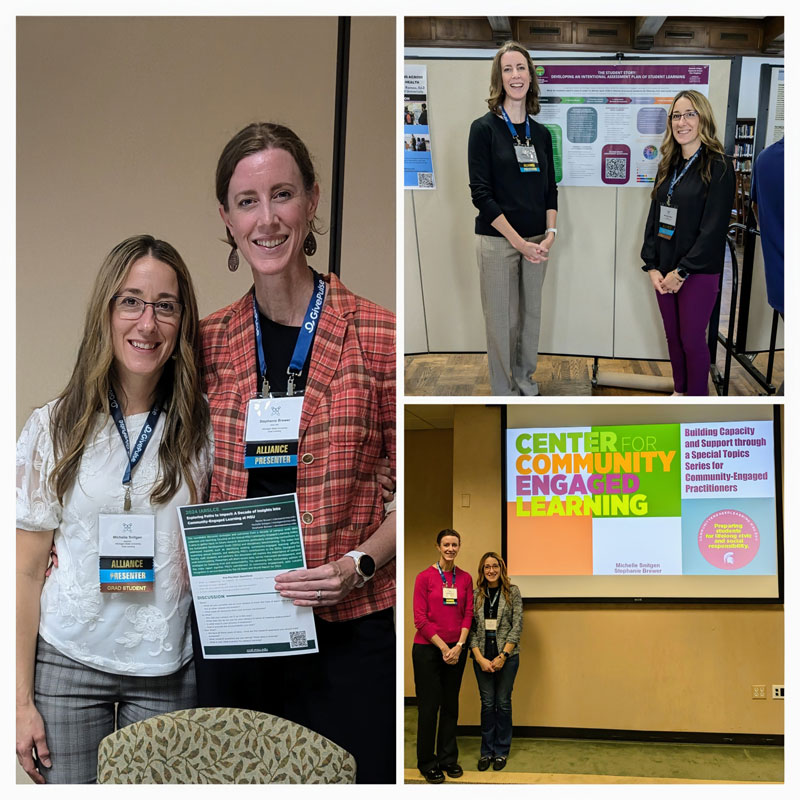
Clockwise from left: Snitgen and Brewer shared their insights on fostering community-engaged learning at MSU through a roundtable discussion, poster, and presentation at the national IARSLCE conference in San Diego in October 2024.
In addition to these workshops, Brewer and Snitgen conducted over 30 one-on-one and small group consultations with faculty and staff across a wide range of disciplines—representing the Colleges of Arts and Letters, Osteopathic Medicine, Social Science, and Education, along with the Honors College and the Residential College in the Arts and Humanities. These tailored sessions allowed for deeper engagement with key CEL resources, such as the Community-Engaged Syllabus Workbook, 101 Ways to Reflect, The Elements of Successful Partnerships, and the Course Development Guide.
A notable highlight was the faculty learning community Anti-Racist Community-Engaged Learning at MSU: From Theory to Practice, supported by the Office of Faculty and Academic Staff Development. Participants engaged deeply with contemporary scholarship and are co-authoring a reflective self-study.
The team also expanded its impact on students, supporting critical reflection workshops for 1,202 students and facilitating community-engaged placements for 598 students across 24 courses. The Social Innovation Speed Pitch workshop—developed with MSU’s Burgess Institute for Entrepreneurship & Innovation—evolved into a multi-session experience for MSU’s Spartan First-Generation Leadership and Innovation (FLI) Program, where students explored design thinking and social change.
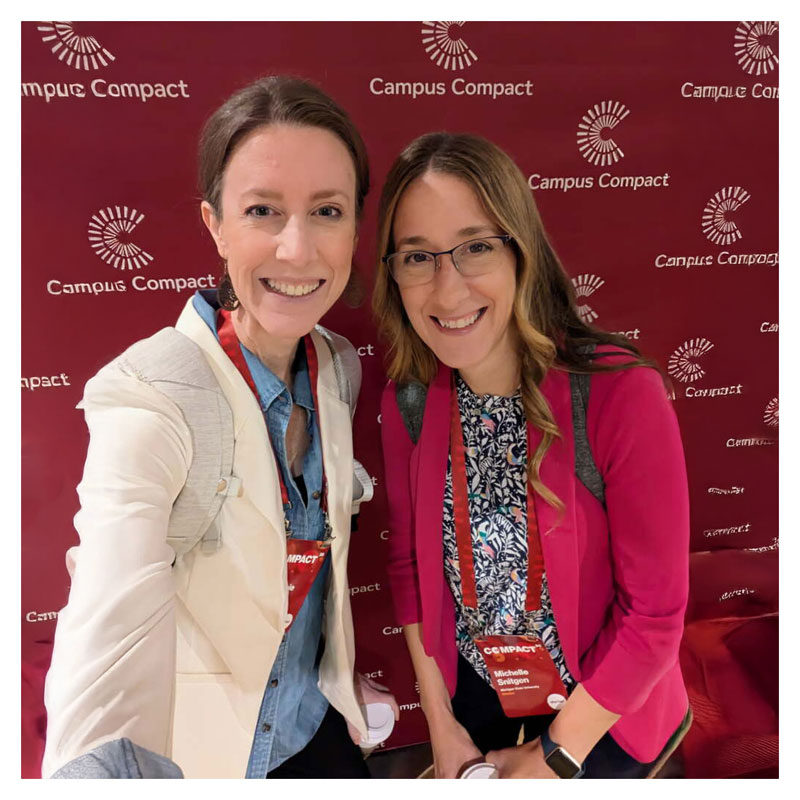
Throughout the year, the academic community-engaged learning team shared its work nationally, presenting on the Faculty Special Topics Series at IARSLCE and highlighting its learning community model at Campus Compact 25 and MSU Spring TALKS. These efforts underscore the team’s continued role in fostering an equity-centered, thriving culture of community engagement at MSU.
To learn more about how CCEL supports academic community-engaged learning, visit the faculty page of our website or contact Michelle Snitgen at msnitgen@msu.edu or or Stephanie Brewer at sbrewer@msu.edu.