University Outreach and Engagement The Graduate Certification in Community Engagement: Promoting Professional and Scholarly Partnerships
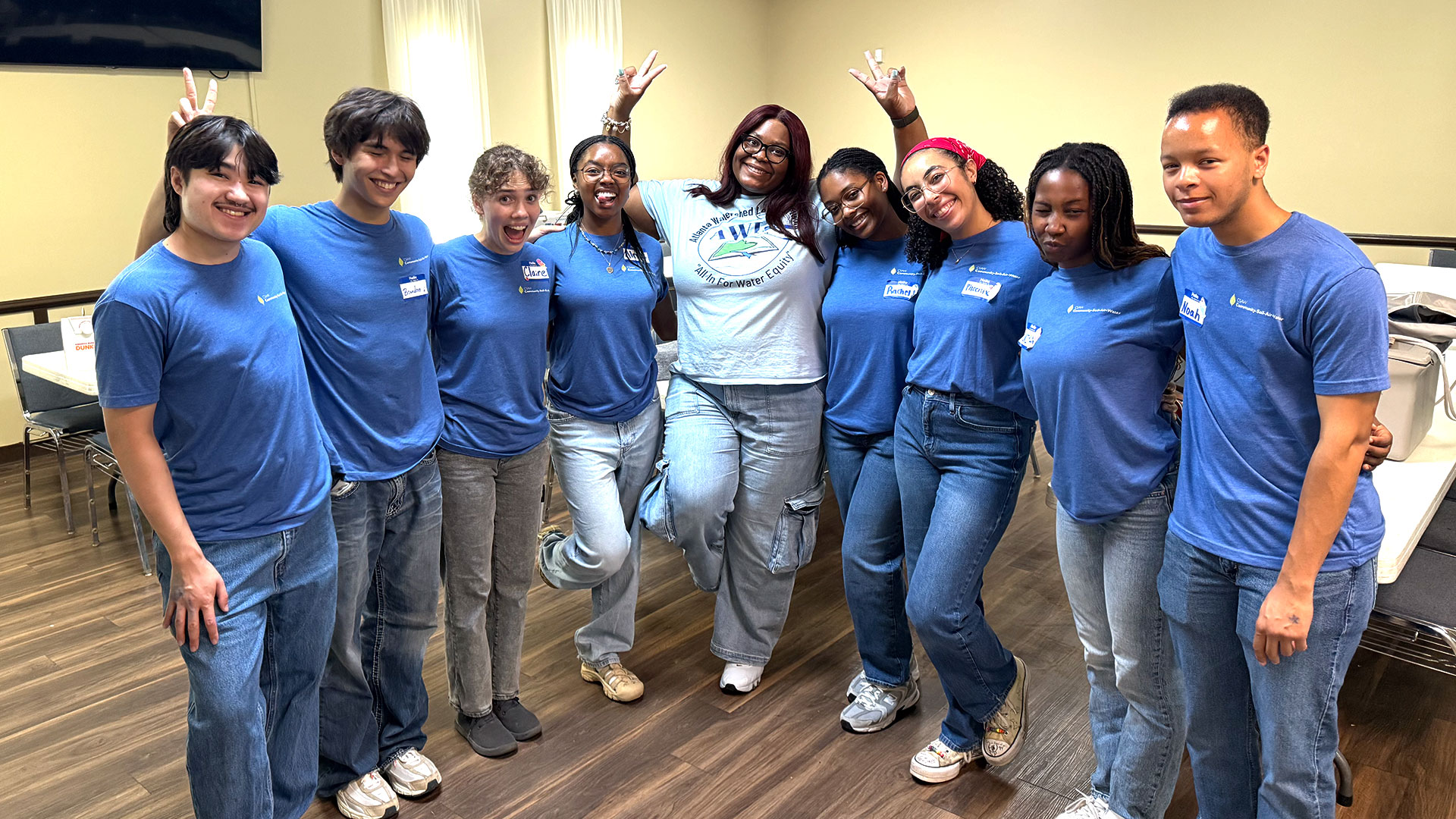
Ph.D. and community engagement certification student Angelique Willis (center) poses with student interns from the Community-Soil-Air-Water program at Georgia State University’s Department of Geosciences. Willis worked with this team of interns to coordinate logistics for a symposium hosted by the Atlanta Watershed Learning Network Alumni Group.
Community-engaged learning at Michigan State University isn’t exclusive to undergraduates—graduate students also arrive on campus excited to make a difference. The graduate certification in community engagement offers grad students a meaningful addition to their degree that prepares them for any form their future work with communities may take.
This certification, administered by University Outreach and Engagement (UOE) and the MSU Graduate School, helps graduate and professional students develop systemic, respectful, and scholarly approaches to their community-engaged work. “We want students to have an opportunity to use what they’re learning on campus to make a difference in the lives of everyday people,” says Diane Doberneck, coordinator of the graduate certification and director for faculty and professional development in the Office for Public Engagement and Scholarship in UOE.
Following 2 years of research and development by a planning committee, the graduate certification was established in 2009. Complementary to their studies within their home departments, students learn key engagement principles through workshops, engage with a community partner on a mentored project, and complete and present a written portfolio. This three-part structure, based on the Graduate School’s certification in college teaching, has remained consistent since the program’s development, but competencies in which students are trained have evolved.
“The subject matter has changed a lot over time, and I hope that it keeps changing in relationship to what’s happening to the world, what our students arrive on campus knowing, and what they want to know more about while they are here,” Doberneck says. At first, workshop topics were based on the teaching interests of the committee members. Doberneck later observed gaps between offered topics and portfolio expectations, and the committee revised the content. “There’s a growing literature about professional development for graduate students through community engagement. We’re constantly looking at that for new ideas, and then reshaping.”
Every fall and spring semester, Doberneck would lead weekly interactive workshops covering the history of community-engaged scholarship, partnership building, critical reflection and ethics, evaluation of partnerships, career pathways, and more. Recently, she has condensed these workshops into a 2-day institute each semester. Students pursuing the certification attend both institutes to learn the competencies they are required to demonstrate in their partnerships and portfolios.
At the core of the certification are community-engaged projects mentored by partner organizations beyond campus. Most students identify their own project based on their dissertations, jobs, and hobbies, while UOE helps others identify partners with projects related to their program and skills. In either case, the project is primarily guided by their community partners and a professor with whom the student works.
Available to graduate students in all colleges at MSU, the certification draws students from a range of places, disciplines, and career pursuits. Projects can encompass research, artistic expression, service learning, nonprofit work, or other implementation avenues, and students may connect with partners locally or from another state or country. In 2025–2026, graduate students presented portfolios in subject areas including microbial sciences, business management, cultural anthropology, and teacher education.
One student, Angelique Willis, worked with the Atlanta Watershed Learning Network (AWLN) Alumni Group toward challenging cycles of environmental injustice. Willis is a Ph.D. student in geography and environmental science and policy from Atlanta, and she has collaborated with the AWLN on strategic communication since 2023. As her project for the certification, Willis chaired a committee that planned a symposium highlighting how community members can recognize and bring awareness to ways that infrastructural gaps show up in their homes and neighborhoods.
“I came into this partnership carrying two truths at once: I am from Atlanta, and this work is personal, and I am also a university-trained researcher with access, credentials, and institutional language that can shift power in a room even when I do not intend it,” Willis writes in her portfolio. “Being ‘from here’ helped build rapport because I understood the cultural rhythms of church spaces, neighborhood storytelling, and the way trust is earned through consistency rather than titles. At the same time, my education and professional experiences can easily position me as the person others look to for answers, approval, or direction.” About this contrast, she emphasizes, “I had to be intentional about resisting that pull.”
Addresses connecting civil rights history to today’s environmental challenges and highlighting partnerships in support of environmental protection and racial equity bookended this event. Throughout the symposium, community advocates offered examples of initiatives promoting environmental justice within Atlanta, and poster presenters invited attendees to consider data-driven approaches in organizing for a healthier community. Later, community members received folders with practical guidance on noticing everyday environmental injustices, such as repeated flooding and odors or emissions near homes and schools, and contact information for policymakers to address these issues.
For the AWLN Alumni Group, the symposium’s success demonstrated planning processes that members can sustain in their future environmental justice efforts. “People rarely commit to a process because of a single meeting,” Willis says. “They commit because they trust the people in the room, because they feel respected, and because they see follow-through.”
Upon completion of the institutes and their mentored projects, students write portfolios that, like Willis’, summarize their experience and reflections on the community and personal impact of their engagement. Students then present these portfolios to practice public speaking and celebrate their work with fellow community engagement practitioners.
“We’re pushing them to write differently than they would for a research report or a class,” Doberneck shares about the emphasis on reflection in these portfolios. “We're asking students very specifically to reflect on the connections they see, personally and professionally, to their mentor community engagement experience and to the workshop content.”
“Professionally, the symposium reshaped my craft,” Willis shares. “I now build from a clear need and measure what matters to the people who named it. I write in the language of the community, not the jargon of the university, and I design evaluations that feel like service, not surveillance. I now understand more that ‘place’ teaches, so venue, signage, pace, and food are not extras. They are part of how knowledge moves from a podium into a neighbor’s life the next morning.”
Through the certification’s steps, students are encouraged to consider how community engagement principles and practices will show up in their future work. The portfolio can serve as a tool for documenting new skills that students gain during their engagement, such as project management, group decision-making, and ethical codes tailored to community engagement in their discipline. In addition, the program offers students who are already committed to community work the opportunity to extend it without pausing for their graduate studies.
“Some of our home departments do not have a way of accommodating a graduate student’s commitment to community work,” Doberneck notes. “They either have accredited curriculum where there’s no room for it, or they have a strong disciplinary focus. It’s important that, if we have graduate students coming to Michigan State with these passions, we give them pathways to learn and grow.”
“College cracked something open for me,” Willis shares about her engagement journey. “I learned that research could be service, that planning could be companionable, and that scholarship could sit in a folding chair next to a neighbor and ask, ‘What would make tomorrow better?’ That realization reshaped my sense of what a ‘professional’ looks like in community spaces.”
Graduate students interested in learning more about the certification can visit gradcert.engage.msu.edu.