Academic
Community-Engaged
Learning
Helping faculty and academic staff integrate community-engaged learning into courses.
CCEL Academic Programs Team: Advancing Community-Engaged Learning Through Faculty Engagement and Partnership - Michelle Snitgen & Stephanie Brewer
Throughout the 2025-2026 academic year, the Michigan State University Center for Community Engaged Learning (CCEL) Academic Programs Team continued to strengthen and expand support for faculty, academic staff, and instructors interested in integrating community-engaged learning into their courses. Through workshops, learning communities, consultations, conference presentations, and national collaborations, Academic Program Team members and CCEL Assistant Directors Michelle Snitgen and Stephanie Brewer provided opportunities for educators to explore, design, refine, and assess community-engaged teaching and learning practices that enhance student learning while strengthening communities and contributing to the larger body of scholarship informing the field.
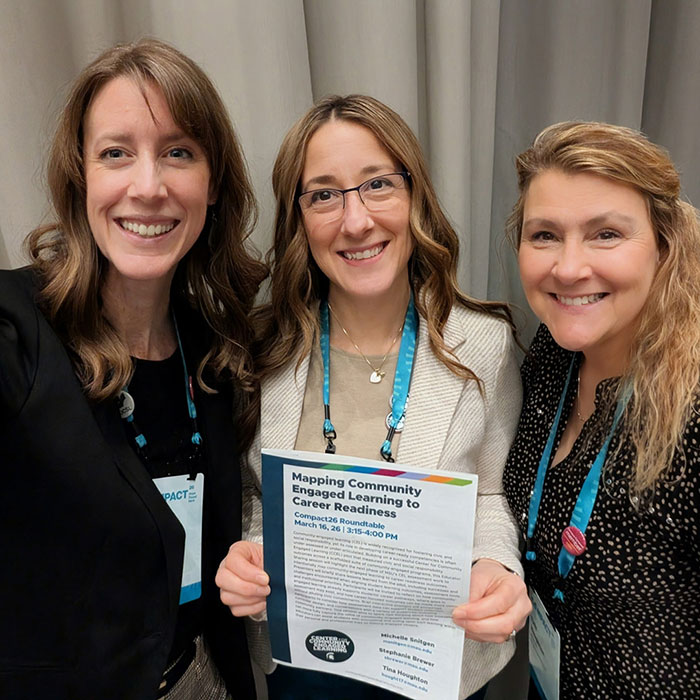
(Left to Right) CCEL assistant directors Stephanie Brewer, Michelle Snitgen, and Tina Houghton with their roundtable handout, titled “Mapping Community Engaged Learning to Career Readiness,” at the Compact26 conference on March 16, 2026
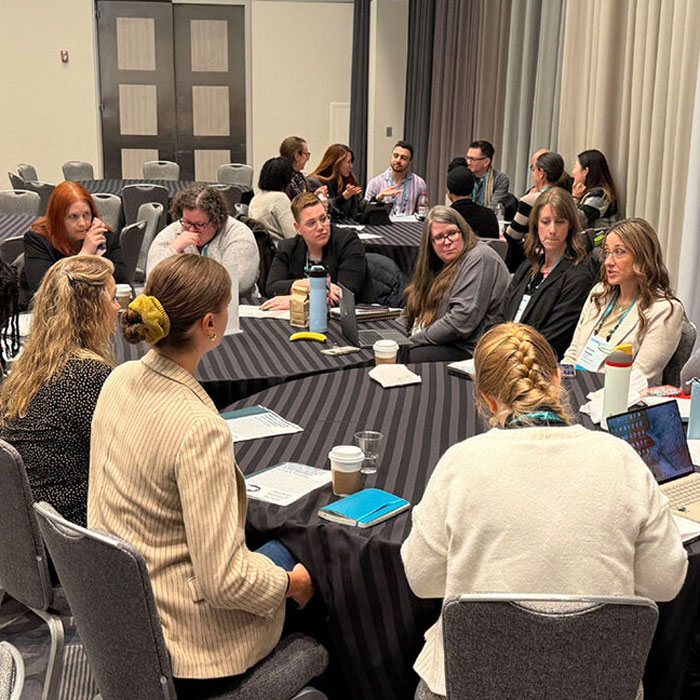
Academic Program Team members Stephanie Brewer and Michelle Snitgen (back of front table) speak at their roundtable with assistant director Tina Houghton (front of table, second from left) at the Compact26 National Conference on March 16-18, 2026 in Chicago. This roundtable, titled Mapping Community-Engaged Learning to Career Readiness: Advancing Student Learning Assessment, focused on the team’s pilot learning outcomes for community-engaged student programs.
Recognizing that community-engaged learning (CEL) takes many forms across disciplines and contexts, the Academic Programs Team intentionally designed programming that can support both experienced practitioners and those new to CEL. Efforts focused on providing adaptable tools, resources, and peer-learning opportunities that faculty and staff can tailor to their own courses, community partnerships, student populations, and learning objectives.
One of the team’s primary faculty development offerings was the Special Topics Series for Community-Engaged Learning Practitioners, a workshop series designed to help educators strengthen specific aspects of course-based CEL. Sessions addressed topics including creating or refining CEL syllabi, developing rubrics and reflection strategies, building effective community partnerships, and enhancing the student experience within community-engaged courses. Across four sessions during the academic year, the series engaged a broad audience that included hundreds of MSU faculty and staff, community partners, and colleagues from institutions across the country. Attendance reflected growing interest in community-engaged pedagogy and the value of creating spaces where practitioners can learn from one another while exploring practical approaches to implementation.
In addition to structured workshops, the Academic Programs Team continued to offer individualized support through Hooked on Community-Engaged Learning: Consultation and Coffee. Held at Hooked Bookstore in East Lansing, these informal gatherings created opportunities for faculty and staff to engage directly with CCEL staff around their specific teaching and partnership goals. Conversations ranged from course design and syllabus development to community partnership cultivation, student preparation, logistics management, and reflection strategies. Six consultation sessions were offered throughout the year, engaging faculty and staff from a wide range of colleges, departments, centers, and administrative units. Participants represented areas including Nursing, Human Medicine, Osteopathic Medicine, Agriculture and Natural Resources, Law, Arts and Letters, Social Science, Packaging, Psychology, African American and African Studies, Theatre, and numerous interdisciplinary and outreach-focused units. The breadth of participation highlights the growing integration of community-engaged learning across disciplines and demonstrates the values of personalized consultation as a complement to larger professional development efforts.
"These efforts continue to advance CCEL’s mission of preparing students to engage thoughtfully and collaboratively with communities while creating meaningful social impact through teaching, learning, and partnership."
The Academic Programs Team also facilitated a yearlong learning community titled Community-Engaged Partnerships and Emergent Strategy: From Theory to Practice. Grounded in the principles of community-engaged learning and informed by Adrienne Marie Brown's Emergent Strategy with emphasis on relationships, adaptability, and systems change, the learning community invited participants to critically examine partnership development, compensation practices, and the distinctions between transactional and transformational community relationships. Fifteen faculty and academic staff members participated, representing disciplines and units across the university, including Community Sustainability; Nursing; Education; Human Biology; Agriculture and Natural Resources; English; Writing, Rhetoric, and Cultures; Lyman Briggs College; Integrative Studies in Social Science; and the College of Social Science Dean’s Office. Through discussion, reflection, and collaborative learning, participants explored how community-engaged teaching can foster more equitable and reciprocal partnerships while advancing meaningful student learning outcomes.
Beyond campus-based programming, the team contributed to broader conversations about student learning, assessment, and community engagement through conference presentations and national collaborations. During the year, Snitgen and Brewer partnered with CCEL Assistant Director Tina Houghton to present at both the national Campus Compact Conference and MSU Spring TALKS. These presentations highlighted CCEL’s emerging work around student learning outcomes and assessment, including the center’s pilot process for designing, implementing, and evaluating learning outcomes across community-engaged experiences. Presentations emphasized a holistic approach to student development, illustrating how community-engaged learning contributes to civic responsibility, social awareness, and career readiness while exploring opportunities to more intentionally connect community-engaged experiences with career competencies.
The team's leadership also extended to the national stage through participation in the Campus Compact Community of Practice: Evaluating Community Engaged Activities. Invited by Campus Compact, CCEL Executive Director Renee Miller Zientek, Brewer, and Snitgen convened and facilitated a yearlong community of practice focused on assessment, evaluation, and data-informed storytelling related to community-engaged learning. Drawing heavily on Michigan State University's Community-Engaged Learning Index process, the community of practice brought together 32 registrants representing 30 colleges and universities from across the United States. Throughout the year, participants engaged in collaborative discussions focused on expanding knowledge and awareness of assessment practices, strengthening evaluation strategies, enhancing data collection and tracking systems, improving storytelling and communication of outcomes, and translating assessment findings into institutional action. The community of practice positioned data not simply as a reporting mechanism but as a tool for demonstrating impact, strengthening partnerships, fostering accountability, and advancing higher education’s public purpose. The strong participation from institutions nationwide further affirmed the growing interest in meaningful approaches to assessing and communicating the value of community-engaged learning.
Collectively, the Academic Programs Team’s efforts during the 2025–2026 academic year demonstrate CCEL’s continued commitment to supporting faculty excellence, fostering innovative teaching practices, and strengthening community-engaged learning across Michigan State University and beyond. Through workshops, consultations, learning communities, scholarly dissemination, and national leadership, the team expanded opportunities for educators to build their capacity as community-engaged practitioners while contributing to broader conversations about assessment, partnership development, and student learning. These efforts continue to advance CCEL’s mission of preparing students to engage thoughtfully and collaboratively with communities while creating meaningful social impact through teaching, learning, and partnership.
For the 2025-2026 academic year, there were
10,371 student community-engaged learning registrations