School of Residential Community-Engaged Arts and Humanities The Prison Arts Project: Building Empathy and Self-Expression Between Students and Incarcerated Participants
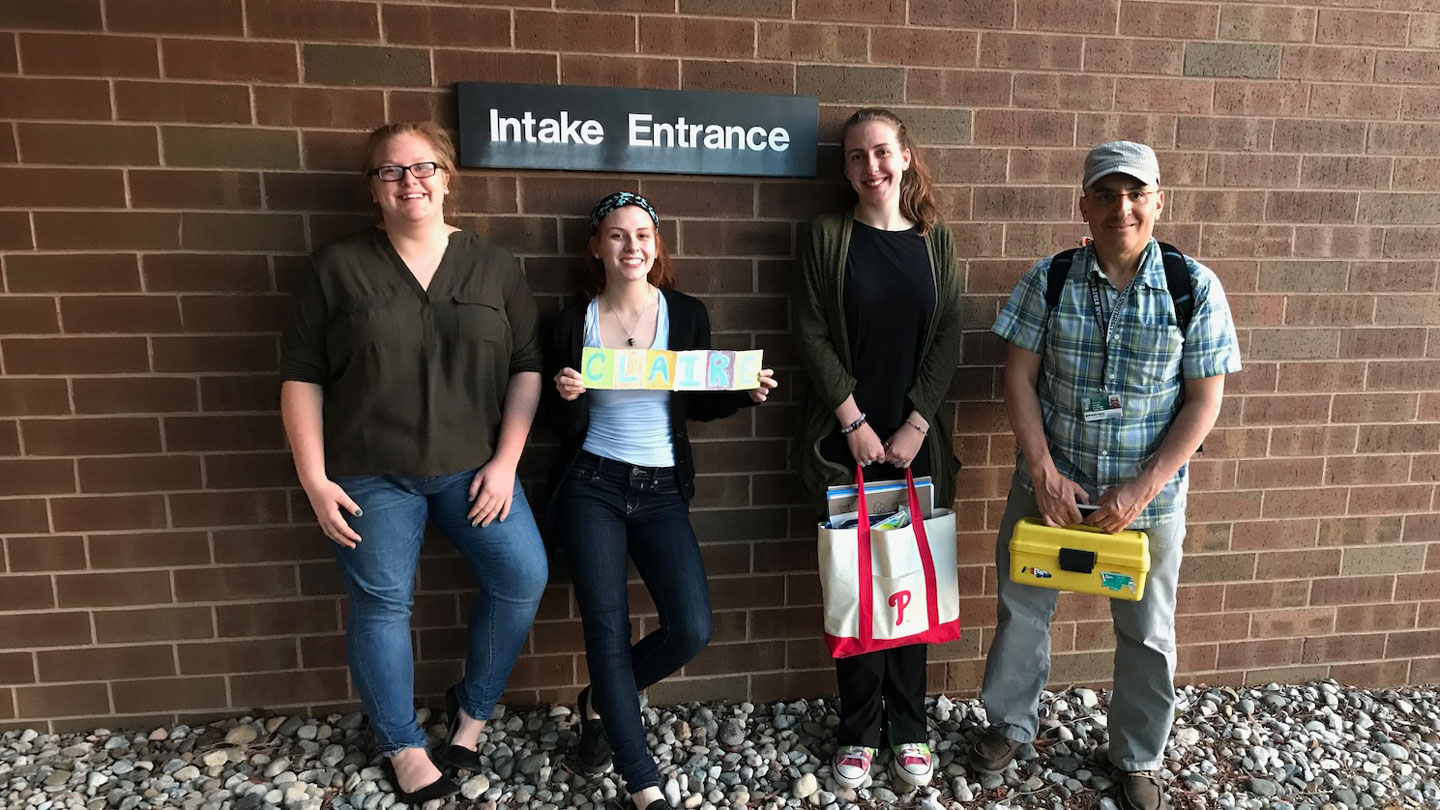
A group photo of Prison Arts Project students and professor Guillermo Delgado (right) at the ICYC intake entrance.
For incarcerated people, art can be a powerful outlet to freely express their true selves separately from their past actions. The Prison Arts Project brings workshops in visual arts, poetry, and music to youth detention centers and adult correctional facilities to share creative experiences and dialogue between MSU students and those living on the inside.
Guillermo Delgado is an academic specialist in the School of Residential Community-Engaged Arts and Humanities (RCAH), formerly the Residential College in the Arts and Humanities. Prior to starting the Prison Arts Project in 2014, he engaged RCAH students in Art at Work, an installation of pieces telling the stories of employees at Peckham, a manufacturing company that hires people facing barriers to employment.
From this partnership, Delgado met a supervisor of adjudicated youth employees, who later left to work at the Ingham County Youth Center (ICYC). This supervisor invited him to ICYC to see sketches and listen to poetry by youth incarcerated there.
“I was blown away by this experience, and I didn’t want to cry in front of anybody,” Delgado says. “My mind was spinning. I started to wonder, ‘What if I assembled a group of RCAH students who were really into civic engagement?’”
Moved by this meeting, he invited eight students from Art at Work to go back to ICYC and facilitate a workshop. Student feedback on this and subsequent workshops was overwhelmingly positive, and Delgado turned the project into a course that he teaches every fall and spring semester. The project also inspired a registered student organization that continues its mission beyond the classroom, Creative Collaboration with Incarcerated Youth (CCIY).
“The Prison Arts Project has provided me with the opportunity to become more involved with my community in Lansing, and to think critically about the societal systems that influence youth incarceration,” says student and founding CCIY member Abigail Bowers.
Each semester starts with a crash course on mass incarceration in the United States. Documentaries help explain the subject, and loved ones of people in correctional facilities and formerly incarcerated painter Martín Vargas visit as guest speakers. Students also practice drawing and writing poetry in the first few weeks of the class. After this preparation, they spend 5 weeks facilitating workshops with youth and 5 weeks with adult participants.
“The semester flies, and after their first visit, the students want to spend as much time as possible working in the facilities,” Delgado shares. About introducing students to mass incarceration, Delgado says, “It’s important for students to understand why things are the way they are before we go in.”
At ICYC, RCAH students hold weekly workshops that encompass a variety of art forms. Along with writing and visual arts, Delgado and his students started to incorporate music thanks to a grant that allowed them to purchase ukuleles, a bass, and percussion equipment. Since sentences for incarcerated youth are shorter than for adults, Delgado’s students design these workshops as one-day experiences, at times with input from Lansing School District to complement their required curriculum for district students inside.
“This experience gave me deeper insight into the impactful collaboration of academia with communities,” says Jeevan Karki, a Ph.D. student and graduate fellow Delgado mentors. Karki joined the class for a workshop where participants worked together in groups of three to draw a complete picture. One person started drawing, the other group members added details, and the group would share their work. “Arts not only evoked smiles, joy, memories, and hopes, but also opened avenues to articulate their perspectives and envision their dreams,” he says.
One activity that opens the door to understanding between MSU students and youth participants, Delgado finds, is creating zines about what makes a “good day” in their regular life. “Some [kids] will mention a shower in the morning, and our students are like ‘wait a minute, I take a shower in the morning for granted,’” he says. “Maybe the young person who’s incarcerated wanted to study, but nobody was supportive. Comparing what a good day looks like for two sides is a valuable exercise that develops empathy as a muscle.”
The students also plan a longer poetry workshop series for a small group of participants at Richard A. Handlon Correctional Facility in Ionia, Michigan. New participants are accepted into these workshops each semester, entering with a mix of poetry writing experience. Participants and RCAH students break the ice by writing a haiku every day for 7 days and sharing them as a group. “Using art as a tool for dialogue, you get to know a person who’s just like you but has experienced some barriers that prevented them from making better choices,” Delgado says.
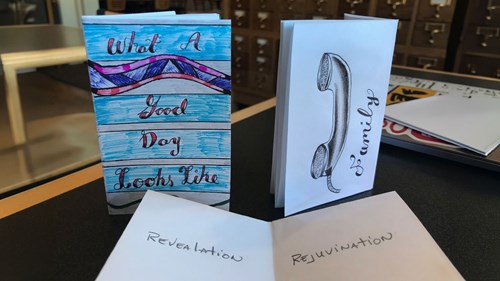
Examples of zines designed by youth incarcerated at the Ingham County Youth Center. During the workshop where these were made, participants were asked to use these zines to share what a good day looks like for them.
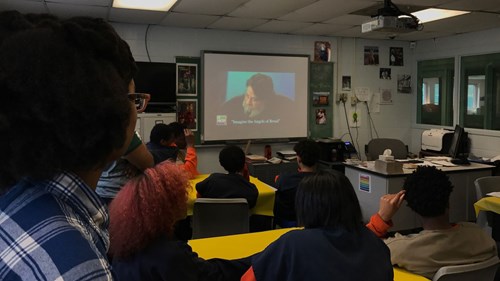
Participants at ICYC and MSU students watch a recorded poetry reading in preparation for a poetry workshop.
“When you’re in prison, you have a persona that you have to be while you’re here,” a warden from the facility told the Lansing State Journal in 2018. “This program, bringing these students in here, actually allows them to be the person that they really are. Even if it’s just for an hour or two at a time, you get to see who the real person is.”
By offering an outlet for participants’ true self-expression, students can also support mental wellness in systems where incarcerated people can feel disconnected from themselves and their lives. Delgado shares that participants present their work during family visits and have expressed appreciation for the ability to look forward to workshops. “It adds a little more light to the environment,” he notes.
In over 10 years of the project, input from participants has shaped how Delgado and his students design their programming. For example, rather than simply reading their poems aloud at their final workshop for the semester, participants at Handlon wanted to perform in a poetry slam. At both facilities, Delgado and his students also complete workshop activities and present the skills they’ve practiced side by side with participants.
“When you use art as a tool to engage with others, you can take it on the road forever,” Delgado says. He notes that RCAH students enter the Prison Arts Project with a variety of creative talents, and not all of them start with confidence in every medium the workshops use. “It’s awesome to watch how everybody is learning from each other.”