College of Human Medicine Rural Community Health Program: Training Health-Care Providers for All Environments
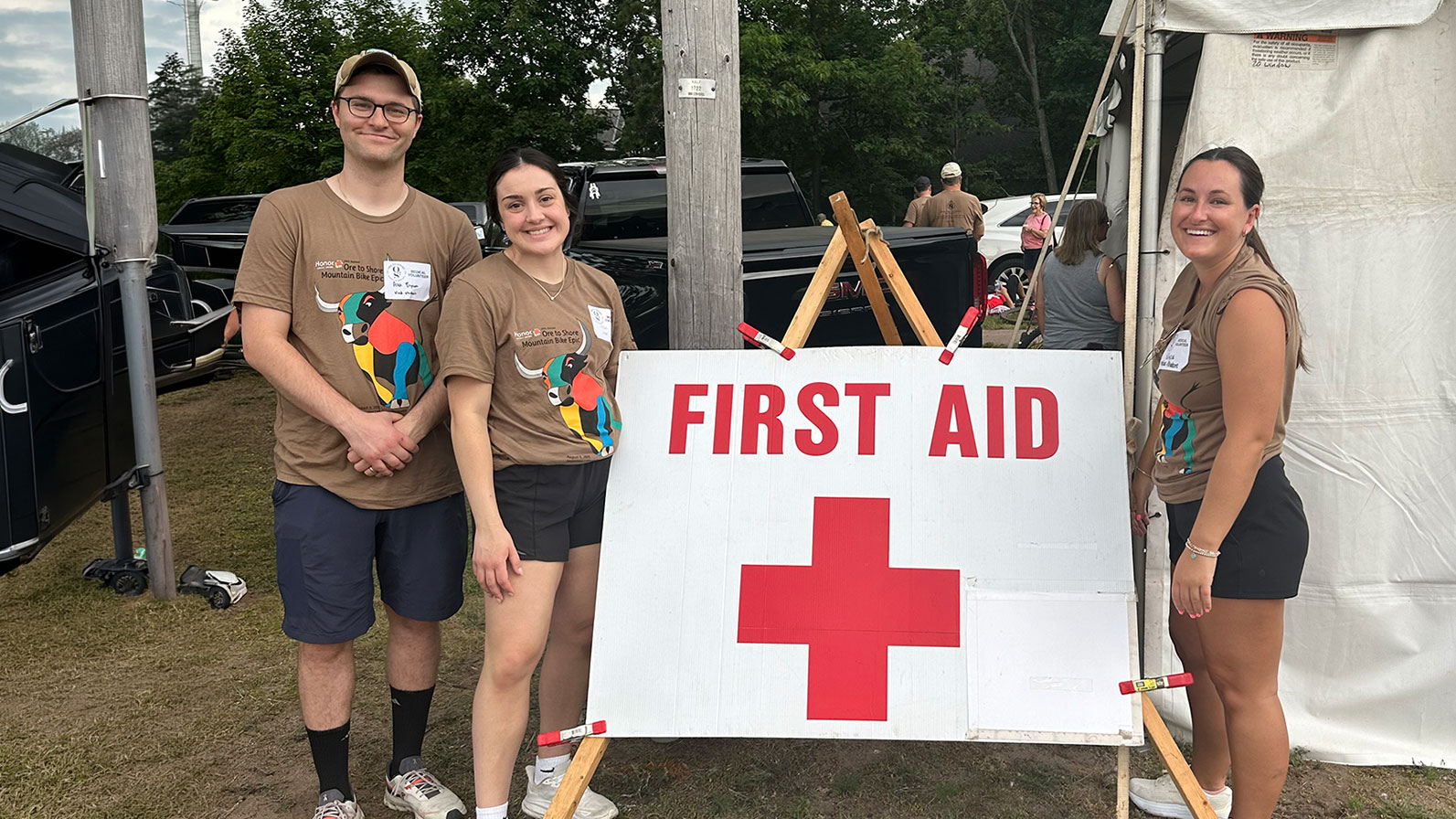
Students in both the Lower Peninsula rural community health program and Upper Peninsula rural physician program volunteer at local events as part of their medical training. These volunteers offer first aid at the Ore to Shore Mountain Bike Epic in Marquette, Michigan.
Medical students often train in urban hospitals, but for those planning to treat rural patients, understanding of these communities’ dynamics and potential barriers to care is a necessity. The Rural Community Health Program (R-CHP) in the College of Human Medicine trains the next generation of these physicians by immersing students in the locations they will serve in Michigan’s Lower Peninsula.
Michigan State University has one of the longest-standing rural medicine training programs in the nation, with the Upper Peninsula (UP) campus in Marquette accepting its first class in March 1974. The college added campuses in Traverse City and Midland in 2009 and 2010, respectively. Complementary to the Rural Physician Program in Marquette, which trains students in health care across the UP, the college developed R-CHP in 2013 for Traverse City and Midland students to train within a rural health system and community.
“It changed from just a clinical experience program to a program where they could deeply invest in the smaller communities where they were assigned,” says Andrea Wendling, M.D., the director of rural medicine curriculum. Wendling oversees R-CHP as a part of Leadership in Rural Medicine and developed R-CHP’s curriculum, serving as its instructor for 10 years.
R-CHP recruits students when they apply to the college so they can start during their first year in medical school. A seminar series invites physicians to introduce students to the program and potential career paths, and a 2-week elective ends the first year with field skills such as casting and suturing. An immersion experience then brings them to rural communities beyond their campuses through work in a primary care office.
“My immersion experience reinforced that rural physicians are often asked to fill gaps well beyond traditional primary care and inspired me to seek additional experiences with mental health,” says Elizabeth Phelps, a third-year R-CHP student at the Traverse City campus. In Boyne City, she found that primary care providers often fill gaps in care that result from limited access to specialists.“The demand for compassionate mental health care was overwhelming, yet the short supply of qualified psychiatrists and counselors in Northern Michigan left many patients waiting for months to be seen while primary care doctors shouldered the burden in the meantime,” Phelps explains.
In their third year of R-CHP, students like Phelps embed themselves in these rural communities for clinical experience, with housing support from local hospital systems. Along with their clinical requirements, students attend community meetings to understand social and economic experiences of those who live there. They are also required to complete 140 hours of volunteer service, often through community events like marathons and immunization clinics. About how students perceive their placements, Wendling gives this example: “Our students would say, ‘I’m a Traverse City-Alpena student’ or ‘I’m a Traverse City-Cadillac student’ because they formed an identity with both of those communities.”
These connections are invaluable, says R-CHP alum Ada Pariser. “[Doctors] have to be able to integrate themselves into the community outside of the walls of the clinic or hospital and understand what medical and nonmedical features of their area are impacting health.” She illustrates some of these considerations: “Is there only one standalone pharmacy that can't maintain stock of drugs your patients need? Is there only one ambulance available across three counties that needs to make trips to a hospital an hour away? Does the town have any cooling or warming shelters for unhoused residents? Do the homes in the area have access to broadband so that they can use modern technologies like the patient portal?”
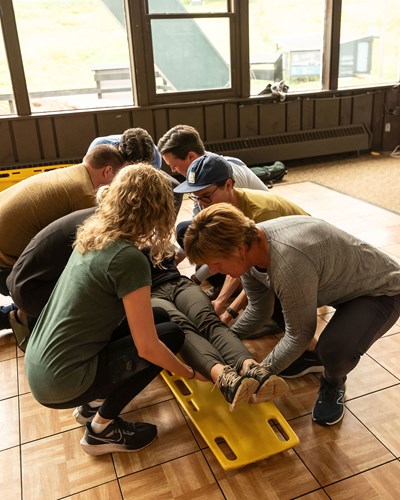
Rural community health students practice lifting a fellow student onto a gurney during their field skills elective course.
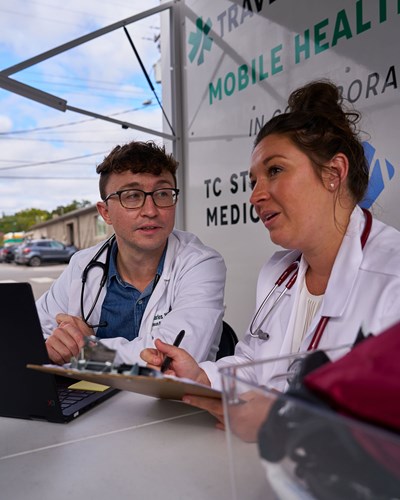
A rural community health student and local doctor provide care at a mobile health clinic in Traverse City, Michigan.
R-CHP culminates in a project where the student, with the county’s leaders and public health department, researches and suggests solutions to a community health issue. Past projects have advocated for creating urgent care centers, developing mobile units, and expanding literature available to a county’s providers. “It can be a big problem or a little problem, but they have to develop a solution that would be feasible for that community,” Wendling says.
Wendling also observes that the physicians who are most likely to practice in rural settings have significant life experience in them, but that only about 4 percent of medical students nationally are from rural backgrounds. “There’s already a significant disparity when you think about how we are going to populate this region with physicians,” she says. “Having a program that seeks to identify rural students, nurture them to that pathway, and give them a place to come together with students of similar interests is important.”
Alum Lis Milligan grew up in Cass City, near Pigeon, and entered her third year in R-CHP during the COVID-19 pandemic in 2020. “I remember attending a virtual Pigeon Rotary Club meeting, where I knew several people in the club—I thought it was cool that attending this meeting was a school assignment,” recalls Milligan, who studied at the Midland campus. “Having exposure to rural medicine allowed me to tailor my residency education to where I knew I would eventually practice. It is easier to become a rural health-care provider when you have seen and experienced rural health care during your education.”
From a young age, Phelps knew she wanted to serve communities like the one she grew up in. “When I applied to medical schools, I specifically chose programs that offered strong rural training tracks,” she recalls. “I heard neighbors, friends, family, and members of my community describe delaying care because they feared being judged or misunderstood. It isn't just about practicing medicine in a small town; it's about earning the trust of a community.”
Experience in rural hospitals also offers R-CHP students the chance to address challenges that may not arise in an urban health-care setting. “If you are a resident looking for a job after graduation and have never been exposed to rural medicine, it is more challenging to take that leap to practicing in the rural area,” Milligan says. From her own residency experience in a nonrural setting, she shares, “I worked to manage my own patients with sleep apnea and osteoporosis, rather than referring to sleep medicine or bone health clinics, because I knew my future patients would need to travel long distances to get to these specialists.”
Exposing future rural physicians to these challenges is an essential part of their training, Wendling says. “The vast majority of medical education in our country is centered in urban communities and large hospital systems because they have a lot of volume that comes through,” she explains. “If you don’t have the opportunity to see how that care is delivered in these lower-resourced settings that are far from tertiary care centers, you simply don’t have those skills.”
By graduation, R-CHP students build a tool kit of place-based best practices they can apply to their health-care careers. “Many underserved communities, both rural and urban, have had too many well-meaning ‘outsiders’ dictate needed improvements without first understanding the community itself,” Pariser says. “The requirements of the Leadership in Rural Medicine curriculum emphasize the need to learn about the community first to understand how to best serve its needs.”