College of Engineering Solving Problems and Maintaining Relationships: Partner Projects in the Data Science Capstone
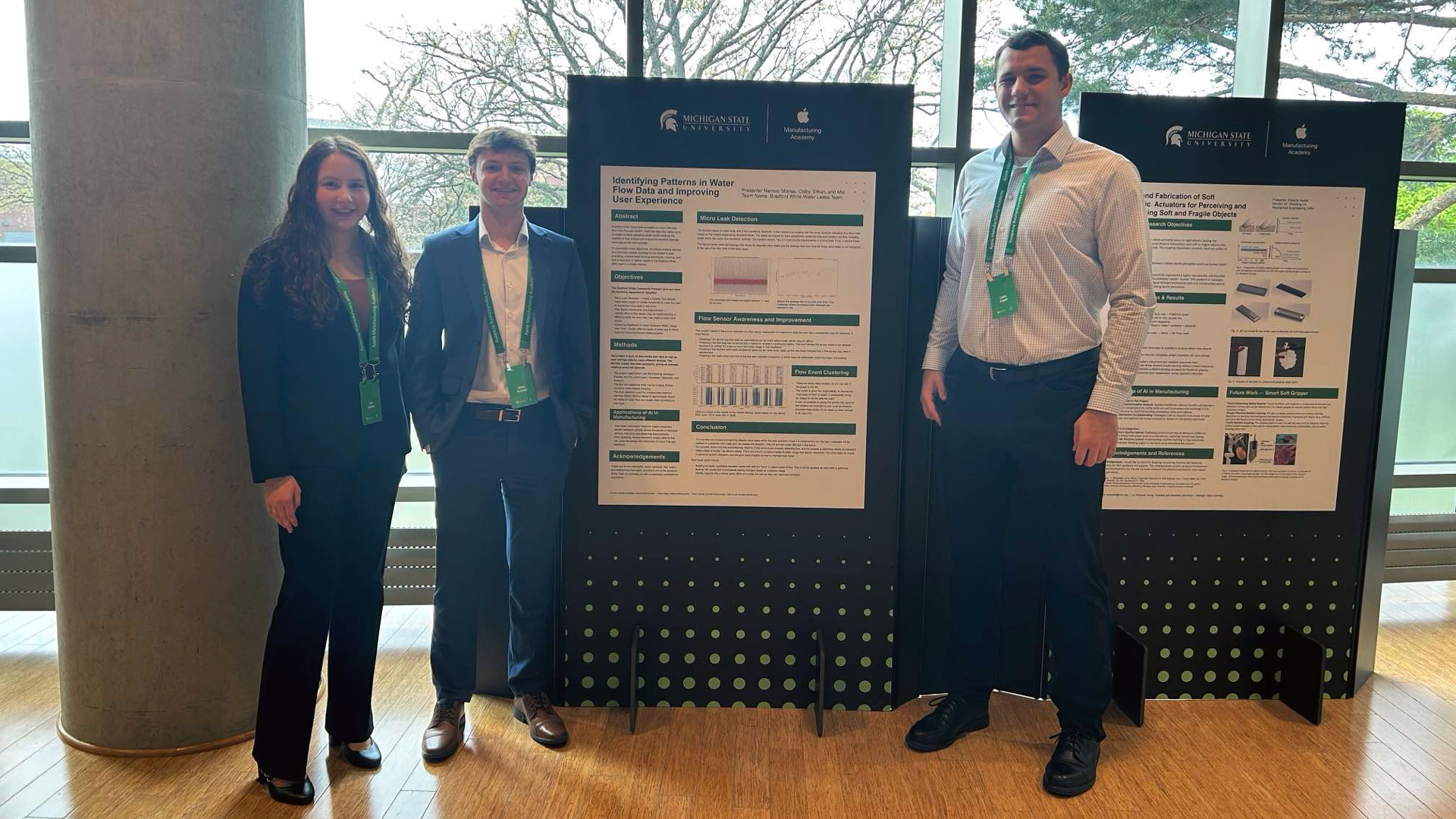
Students (Left to Right) Mia Kunath, Ethan Fremder, and Colby Degan present their project poster, titled “Identifying Patterns in Water Flow Data and Improving User Experience.” They partnered with the Bradford White Corporation to detect leaks in water heaters and improve water usage efficiency for consumers.
Data is everywhere in the digital age, and understanding it can help organizations and professionals further their missions. As they near completion of their degree, data science students complete capstone projects that synthesize their skills, learning to navigate community partnerships and applying their knowledge toward the common good in the process.
At the start of each semester, students read introductions to the work of community partners and their projects, organize into groups based on shared interests and complementary skills and schedules, and get to work. Along the way to their finished products, students learn about each other’s tasks, provide peer review on weekly deliverables, participate in teamwork and communication activities, and engage in workshops about the significance of their projects with CCEL staff.
Above all, the process is guided by weekly check-ins between students and their partners. “Their job is to connect with the community partners and figure out where the projects are going,” says Dirk Colbry, Ph.D., an instructor for the course and senior specialist in curriculum development in the Department of Computational Mathematics, Science, and Engineering. “In every class they’ve ever had, they’ll get homework with an answer, and that’s not how real-world projects work. One of my goals is to teach them what assumptions they’re making and how to change direction.”
Before the academic year begins, Colbry contacts over 600 community partners with a call for student projects. Based on responses, he then meets with partners to determine whether the scope of the project will fit within the semester and offers variety in the causes students can support through their work.
“I try to find projects that have social impact, an impact on the state of Michigan, or an impact on student life,” Colbry says. He also shares that a mix of industries, nonprofits, and governmental agencies each semester is ideal. “I’ve had some big companies that want to sponsor all of our capstones, which is great, but it isn’t what I’m trying to do.”
Through these meetings, Colbry encourages partners to envision a list of all the projects they want to complete and defining their “top N projects,” or the ones they plan to accomplish in a year of regular operations. “I’m interested in the ‘N plus one‘ or ‘N plus 10’ projects—the ones that you’re not going to get to this year but wish you could,” Colbry says. “If our students succeed, you might make a head start on something that you wouldn’t have been able to do otherwise.”
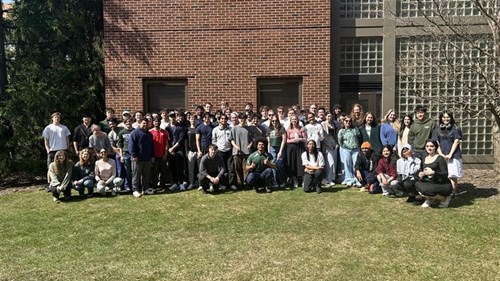
A class photo of Data Science capstone students in a courtyard next to the College of Engineering
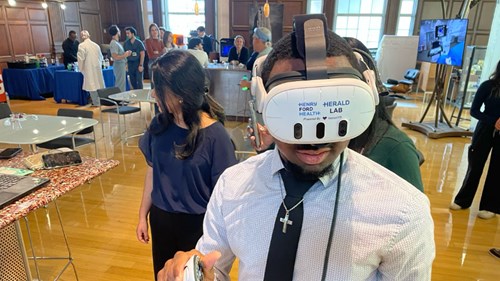
Student Kendall Lesure uses a virtual reality headset from Henry Ford Health to explore current medical imaging technology.
Even in cases where partner projects don’t quite fit the capstone learning goals, Colbry maintains these relationships by referring partners to software and user experience student organizations, faculty researchers, and other departments across campus. “The idea is to build those relationships and make it so that external community partners want to come to MSU, find it a valuable place to engage with students, and get some cool things done,” Colbry says.
In the 2025–2026 academic year, students completed 22 projects, with tasks covering one or more steps in the pipeline of data analysis, modeling, visualization, and storytelling. Partnerships included detection of water leaks for a water heater company to improve their systems’ resource efficiency; mapping overlaps in curriculum across MSU programs; helping West Bloomfield police allocate patrols based on traffic stop and safety data; and developing apps to train entrepreneurs through the startup process.
One project with Henry Ford Health involved the automation of video segmentation during Rapid Ultrasound for Shock and Hypotension (RUSH) exams, which identify life-threatening conditions when patients are in shock. Usually, experienced care providers have to train new staff to provide these exams and manually segment videos at each stage of the exam. Kendall Lesure, a student on this team, shares that having an automated system helps to save time in emergency situations and frees potential human trainers to care for more patients.
“Once you’re on the ground and [your partners] are telling you what this is being used for and the implications of it, it’s eye-opening,” Lesure says. His team converted video from exams into quantifiable data, put this data into a model that generates timestamps, and used those timestamps to segment the video. “I didn’t know what a RUSH exam was at first, so I had to do my own side research about that.”
Occasionally, projects can shift based on updated priorities from the partner. With the open-ended nature of the course, students also run into problems with incomplete data, multiple imperfect solutions, or regular compatibility issues with teammates. For situations like these, Colbry uses class time to prepare students to navigate the partner’s needs and abilities, have confidence in their roles as data scientists, and loop instructors into the conversation if mediation is needed.
“You can easily solve a problem without maintaining the relationship, or you can maintain the relationship without solving the problem, but effective problem-solving is doing both,” Colbry says. “Sure, we want a good project, but when you get into the real world, it’s the people problems that are going to keep you up at night.”
Between the many uses of data demonstrated by community partners and direct experience in teamwork, this capstone course prepares students to use their skills wherever they’re needed. “Data science helps with utilizing the data that’s out there to make decisions, and this class helped us realize how important it can be,” Lesure says. “If you put people together, you can achieve a lot more than you could alone.”