Broad College of Business Supply Chain Engagement with Food Banks: Raising Awareness about Food Distribution
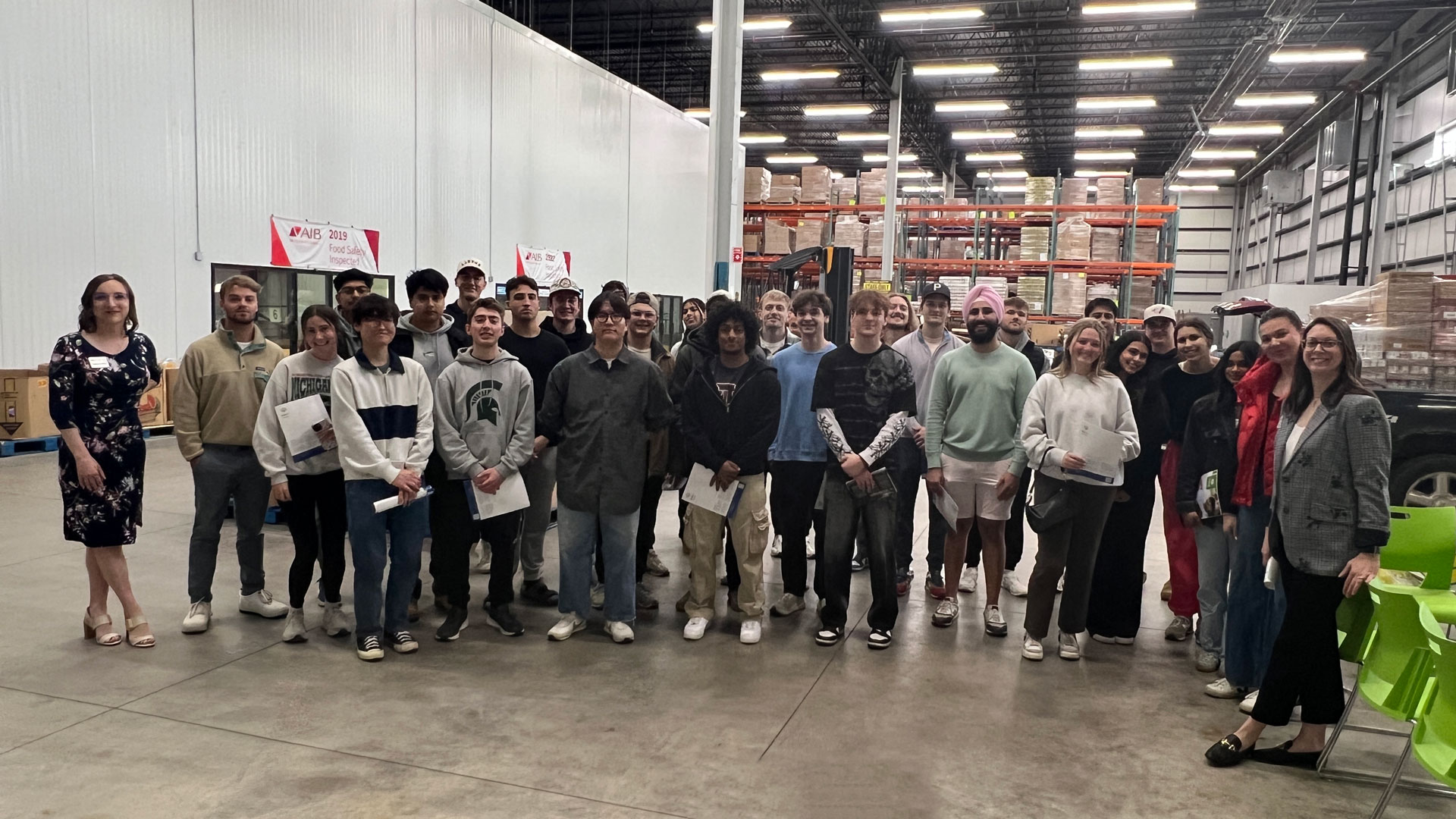
A class photo of supply chain management capstone students with Greater Lansing Food Bank staff in the GLFB’s warehouse. Broad-SCM-WarehouseTour: In a storage warehouse at the Greater Lansing Food Bank, GLFB staff and volunteers explain food bank distribution processes to supply chain management capstone students.
Understanding systems that distribute essential resources can be a key step in promoting fair access to them. In the Broad College of Business, supply chain management students have the chance to explore an especially impactful application of their program: food bank operations and food security advocacy.
“A lot of times, our students go into the corporate world, but I’ve had a lot of students realize we could use supply chain management to work in nonprofits,” says Anne Dohmen, an assistant professor in the Department of Supply Chain Management. Dohmen teaches the department’s capstone course, which has dedicated a class discussion to food bank supply chains and toured Greater Lansing Food Bank (GLFB) operations since the 2023-2024 academic year.
For Dohmen’s class, food banks illustrate the concept of a supply-driven chain, since donations and funding determine what is available to distribute. Another example she highlights is produce—farmers grow as much of their crop as they can, and the market adjusts based on how much of the crop is available. To emphasize this concept, Andrew Kimpel, Michigan State University alum and owner and managing director of Florida-based consulting firm FSC Concepts, LLC, joins the class for an annual guest lecture about his experience with food supply chains.
“It helps [the students] to see it not simply as a food charity, but as a totally different supply chain than what they may have covered in their past 4 years,” Kimpel says. “We have really worked to introduce the concept that fresh produce is a supply-driven supply chain, not a demand-driven one. Shifting that mindset is a game changer in this [supplemental food] supply chain.”
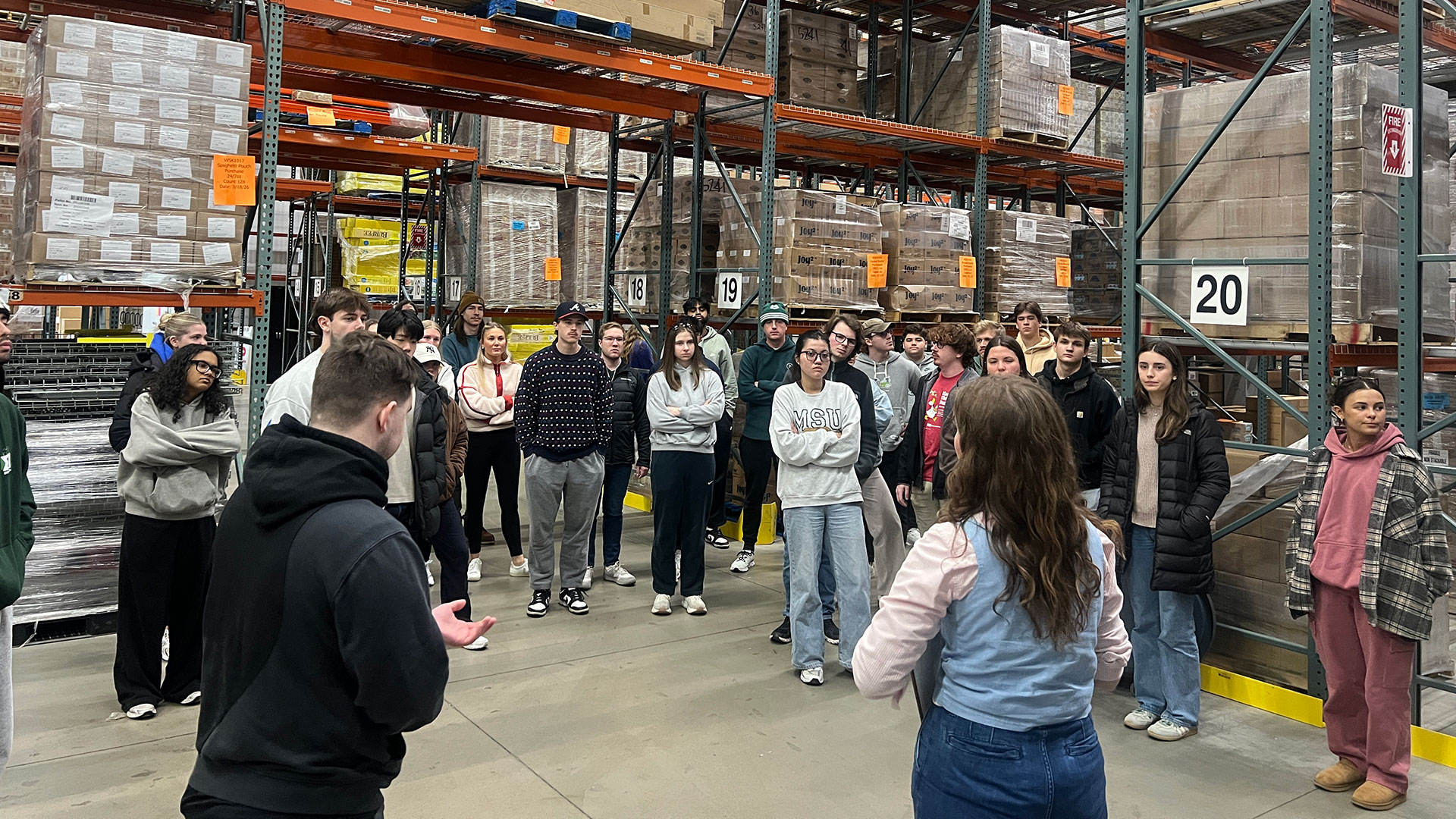
In a storage warehouse at the Greater Lansing Food Bank, GLFB staff and volunteers explain food bank distribution processes to supply chain management capstone students.
Kimpel first came to campus as a guest lecturer through a food policy graduate course taught by Professor David Ortega in the College of Agriculture and Natural Resources. “That conversation was a great reminder of just how interconnected food supply chains are, and how directly they shape questions of food access and food security,” Ortega says. From this initial partnership, Kimpel and Ortega connected with Dohmen to include her students in this opportunity for dialogue.
Over time, this lecture has incorporated interactive discussion with case studies of data provided by FSC Concepts. “Andy Kimpel's guest lecture on his work in the American food bank system was both a brilliant tie-in with our unit on supply-driven systems and an exciting reminder that a career in the world of supply chains can create a positive impact,” says supply chain management alum Patrick Herbst. “Here is a way to use my chosen field to meaningfully help others.”
In spring 2026, Ortega and Dohmen combined their classes to discuss Kimpel’s presentation. “Food policy and Anne's supply chain coursework complement each other naturally,” Ortega says. “My students bring the lens of markets, pricing, and policy, while Anne's students focus on the logistics and operations that move food from one point to the next. Putting those perspectives in the same room produces richer conversations than either could on its own.”
To complement Kimpel’s lecture, Dohmen’s and Ortega’s students met with GLFB staff and volunteers and toured the GLFB’s facilities. In the food bank’s hallway, Dohmen shares, a map of Michigan counties shows the reach of this food bank through smaller pantries and mobile distribution centers. “I think that hits home to [the students] that our communities need this resource,” Dohmen says.
Through this partnership, Dohmen and Kimpel aim for students to recognize how they can use their voices as supply chain professionals to advocate for more equal and efficient distribution of food. Based on his experiences as a consultant for food banks and school districts, Kimpel notes there is a long way to go before the supplemental food supply chain can equitably help those who need it.
“The biggest challenge is getting out of the rut of ‘that’s the way we’ve always done it,’” Kimpel says. “If we flooded the supply lines with food by running a more effective and efficient operation, there would be plenty for everyone. The revolutionary thinking that occurs in these classes could be the start of getting out of the rut.”
For supply chain management alum Lars Ridley, what stood out most from his class’ conversation was how many food banks often continuously stockpile supplies. “The bank being full is great, but when its contents are needed, it should be emptied,” he says.
In Dohmen’s experience, showing students how their studies can drive their work not only for companies and nonprofits, but also the greater good, is important preparation for the communities they visit and live in beyond MSU. “We have these students that want to do good work,” she says, “so this allows for a more rounded experience where they see how they can help their neighbors.”