Center for Community Engaged Learning Highlights: Transportation Support Awards: The 810 Flint Forward Tour
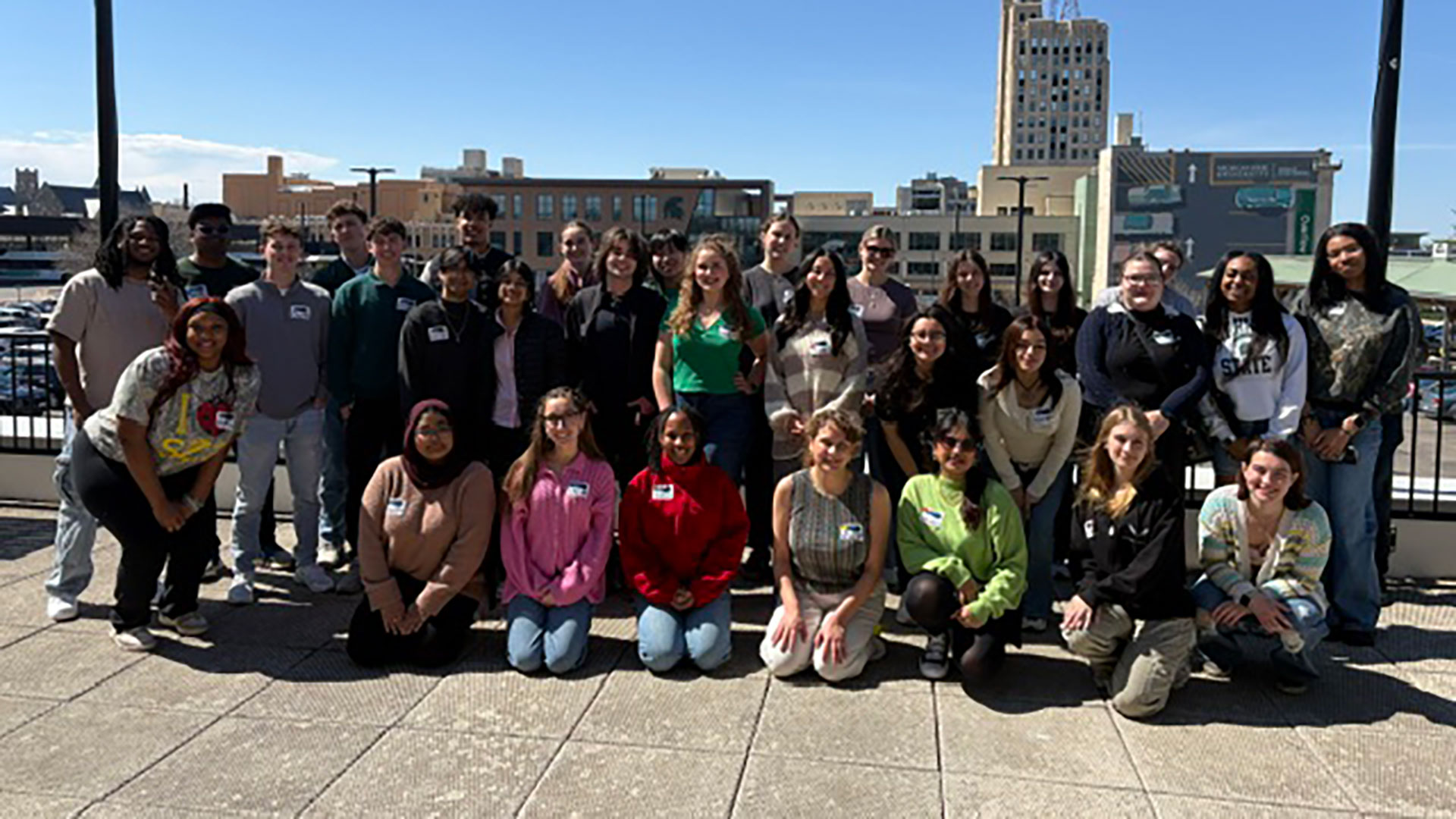
A group photo of the 810 Flint Forward Tour group of MSU students, faculty, and staff on the roof of the Flint Farmers Market, near the CHM Flint Campus.
As part of our commitment to removing barriers to participation in community-engaged learning, CCEL proudly offers Transportation Support Awards (TSAs) year-round to faculty, staff, and registered student organizations. These awards, sponsored by Michigan State University Federal Credit Union, have funded travel for over 1,900 students and counting to connect with community partners across Michigan and beyond.
One recipient of TSA support was the 810 Flint Forward Tour, a one-day program developed and delivered by Catharine White, an academic specialist with the Office for Experiential Learning in the College of Social Science. Students connected with local speakers, community members, and businesses about their love for the Flint community. Piloted this year, the tour serves as a gateway to White’s long-term and sustained co-curricular and extra-curricular experiences in Flint and an introduction to community engagement and place-based learning for students from any college.
“[The tour] aligns directly with experiential learning by translating core disciplinary concepts like inequality, policy, community development, and social systems into lived, place-based understanding,” says White. “Rather than engaging with these ideas solely and indirectly through readings or lectures, students encounter them in real time, real place, and real space through actual community voices, local institutions, and the physical landscape of Flint.”
For the past 5 years, White has managed a summer study-away internship program in Flint. Through several cycles of interviewing prospective “Flinterns,” she found that many students had never been to the city. This motivated White to develop a proposal for the program. In spring 2026, she partnered with Brianna Mosier and Jazzmin Scott at the Flint & Genesee Group to bring the tour to life.
“My hope is that they go to Flint and want to go back, either through an internship program or to look for a job prospect or to do a service learning or community engagement activity,” White says. In her final report about the experience, White shared that many participants’ perceptions of Flint prior to the tour were almost entirely tied to the water crisis and other negative depictions of the city. Acknowledging the difficulties Flint has faced, White set out to disrupt these one-sided narratives.
“When communities are primarily understood through stereotypes or incomplete media portrayals, it can lead to distorted assumptions that influence how people value places and the people who live in them,” White says. “We didn’t just want to highlight Flint’s challenges. We wanted to highlight its innovation, resilience, and leadership.”
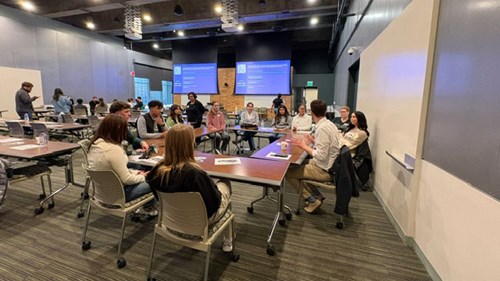
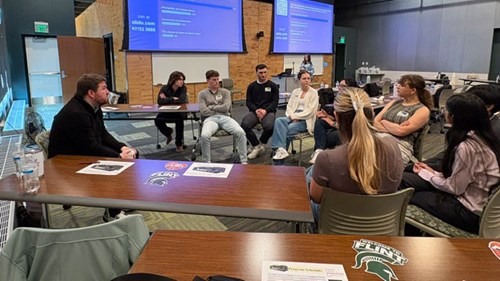
After hearing from Flint community speakers, Flint Forward Tour students had the opportunity to ask further questions about speakers’ lives and work in Flint through roundtable discussions.
On the morning of April 9, 2026, 46 undergraduates and staff from nine different colleges met on campus to take a bus to Flint and engage in a day of discussion and exploration. For part of the tour, participants went on a scavenger hunt that prompted them to visit downtown businesses and chat with the owners.
“Not only did they share with us what their business was about, but also why they love Flint,” says participant Michelle Fortier. Previously a Flintern, she was invited by White to be a part of the inaugural tour and was excited to go back. “These moments were very memorable because we got to actually interact with the community of Flint and hear their personal perspectives,” Fortier says.
“The students I was paired with demonstrated a strong interest in connecting with community members,” said Julie Dixon, program coordinator for Flint initiatives in the Office for Experiential Learning, in White’s report. “They also made several valuable connections with the MSU community, including potential collaboration with student groups, as well as establishing relationships that could lead to future internship or employment opportunities.”
One instruction for the scavenger hunt was for participants to find a “hidden gem.” Participant and past Flintern David Rabinkov, who grew up in Flint and helped lead the tour, visited MW Gallery, the permanent home of the Mott-Warsh Collection of fine art created by artists from the African diaspora.
“The room for self-discovery that [White] left in this trip was really impactful,” Rabinkov says. “I’ve been to the Flint Institute of Arts, but I’d never checked out the MW Gallery.”
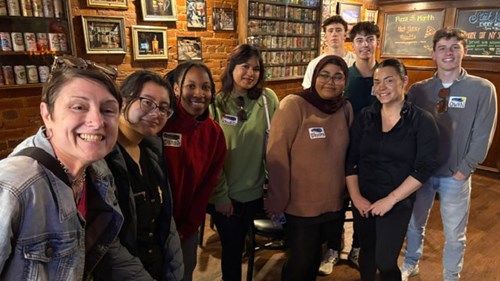
A group selfie of Catharine White (left) and students inside of a Flint restaurant during the scavenger hunt portion of the tour.
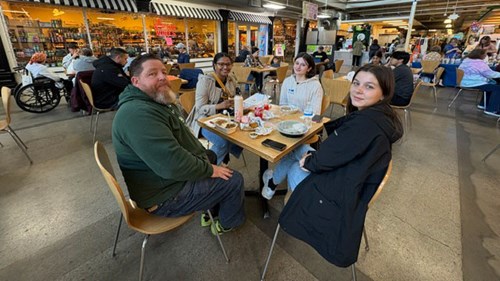
MSU students mingle with community members during lunch at the Flint Farmers Market.
Participant Sophia Clark also visited MW Gallery during the scavenger hunt. “Seeing the passion and creativity displayed throughout the gallery gave me a deeper appreciation for the impact art can have on a community and how businesses can serve as platforms for underrepresented voices,” Clark says.
Later, students met with five community speakers at the College of Human Medicine’s Flint Campus. These speakers shared their perspectives as leaders, nonprofit professionals, and long-term residents, especially as youth growing up in the city. These stories, and the student questions that followed, opened the room to dialogue about the collective story of Flint.
“A memorable moment from the bus tour was seeing the genuine passion that local residents have for Flint and their commitment to reshaping how the city is perceived,” says participant Logan Wilson. “Hearing community members speak so proudly about their neighborhoods, local initiatives, and hopes for the future challenged the narrow narrative that often defines Flint as only a place of water crises and violence.” Wilson returned to Flint in summer 2026 as an intern at the Office of the Genesee County Prosecutor.
“I believe that, to fully understand a community, you must immerse yourself in meaningful conversations directly within that space,” says participant Corinne Mansour. “With Flint, there are often negative and inaccurate narratives surrounding the community, so being able to travel to the city and personally experience the [disproving] of those perceptions and connotations was very important to me.” Mansour returned to Flint in summer 2026 to work on the Rx Kids program.
Feedback about the tour was overwhelmingly positive. A final survey revealed that over 95% of participants liked the structure of the tour, felt engaged with Flint’s history and community, and had their previous perceptions of the city challenged.
“I thoroughly enjoyed the experience and gained valuable insight into the community,” says participant Romy Blum, originally from New Jersey. “Coming from another state, it felt especially important to explore and develop my own perspective.”
“The Flint Bus Tour provided an engaging and educational experience for the students,” Dixon said in White’s report. “I look forward to seeing how future tours continue to enrich MSU students’ experiences and open new opportunities for engagement and growth.”
Rabinkov left Flint as soon as he graduated high school to attend MSU. “Doing the [Flint Study Away Internship] program before drew me to the idea of eventually moving back to Flint,” he reflects. “This trip strengthened that for me because it reminded me that we’re on the come-up and that the community raised me.”
CCEL is proud to support engagement with diverse communities through the TSA thanks to the generosity of MSU Federal Credit Union. To learn more about the Transportation Support Award and apply, visit the Transportation Support Award page on our website.