College of Social Science Sports Are for Everyone: Participatory Research and Networks of Partnership in Adaptive Youth Sports
By Catherine Anger
“SAFE as in baseball safe, but also in that it’s a place for all of these children to safely participate in a sport and feel like they are part of a team.”
Sarah Dunkel-Jackson, Ph.D., a researcher and professor in the Departments of Human Development and Family Studies and Counseling, Educational Psychology, and Special Education, was writing about her work on adaptive youth sports when she realized how neatly the phrase “Sports Are For Everyone” (SAFE) summarizes several community-engaged projects she directs. Through a network of community partnerships and the support of student researchers and volunteers, these projects offer inclusive sports programs that address the strengths and needs of children with disabilities.
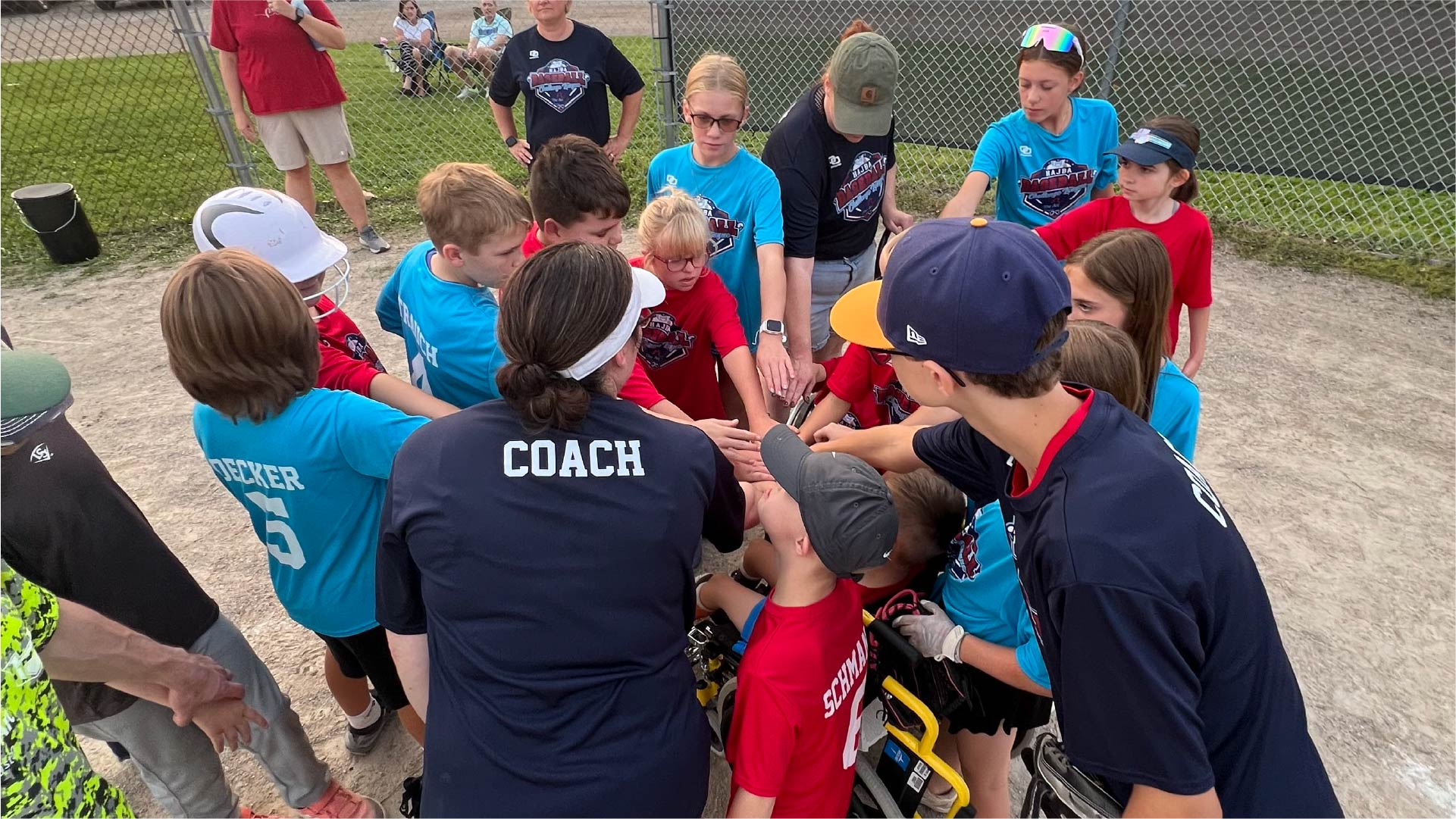
Five years ago, while coaching for the Howell Area Junior Baseball Association, Dunkel-Jackson found that students with unique medical and learning needs were facing difficulties playing on a traditional team. She proposed a program tailored toward the strengths and needs of these athletes, and the Baseball Challenge League was created. Then, she connected with local nonprofit The Arc Livingston, which empowers persons with developmental disabilities and their families, to share the program with members. The organization offered a sponsorship instead.
“We had a lot of community partners who were just amazing, who decided to support this and have continued to support it,” says Dunkel-Jackson. Other partners include the softball team at Cleary University in Howell, Michigan, and MSU’s Research in Autism and Developmental Disabilities (RADD) Lab.
For the fall 2024 season, the league hosted four teams. Each day, the team practiced a different skill, and at the end of practice, players participated in a challenge to demonstrate what they had learned. For example, one practice that focused on hitting ended in the Home Run Derby Challenge. These challenges prepared players to apply their skills at games within the league throughout the season.
“We want to know how they communicate and what they like doing,” Dunkel-Jackson says of surveying the parents of players ahead of the season. These surveys prepare the volunteer coaches, including MSU students, on what to cover in practice. “[Families] can share what the strengths of their kiddo are, and they feel more like we’re adapting it to exactly what their children need.”
The growing capacity of the league is in part thanks to the participation of MSU student volunteers. These volunteers—some of whom are student researchers at the RADD Lab, others who hear about SAFE projects from Dunkel-Jackson’s undergraduate courses—join as coaches to mentor players, gain experience in disability support, and build a sense of belonging. Recent Ph.D. graduate Emily Jensen volunteered as an assistant coach and regularly discussed strengths, needs, and skills with players and their families.
“As a Ph.D. student, I was able to apply what I was learning in the classroom about community-engaged research, supporting children with disabilities and their families, and developing community partnerships,” shares Jensen. “The Baseball Challenge League taught me so much more than I could have ever learned from reading a research paper or attending a lecture and provided me with so much joy.”
With the success of the Baseball Challenge League, Dunkel-Jackson and some of her graduate students conducted a formal program evaluation that asked league team members and their families how they could improve the league. Dunkel-Jackson shares that they replied, “overwhelmingly, ‘we want more sports.’”
The Hockey Challenge Camp was created from this feedback. This summer camp program includes 3 days of practices ahead of a game that is played at Munn Ice Arena. The camp has also grown since its creation to host three to four teams coached by volunteers. The development of this camp is also possible thanks to a network of partnerships, such as with the hockey apparel company Hystyx, whom Dunkel-Jackson was connected to through her own son’s hockey team.
“It was totally a no-brainer for us to support the program,” says Ryan Rabinowitz of Hystyx. Hystyx provides uniforms for the players, apparel for the coaches, and runs the spirit wear store for family members to purchase items that support the camp. “Community partnership is the biggest driver of making something like the Hockey Challenge Camp successful,” Rabinowitz says.
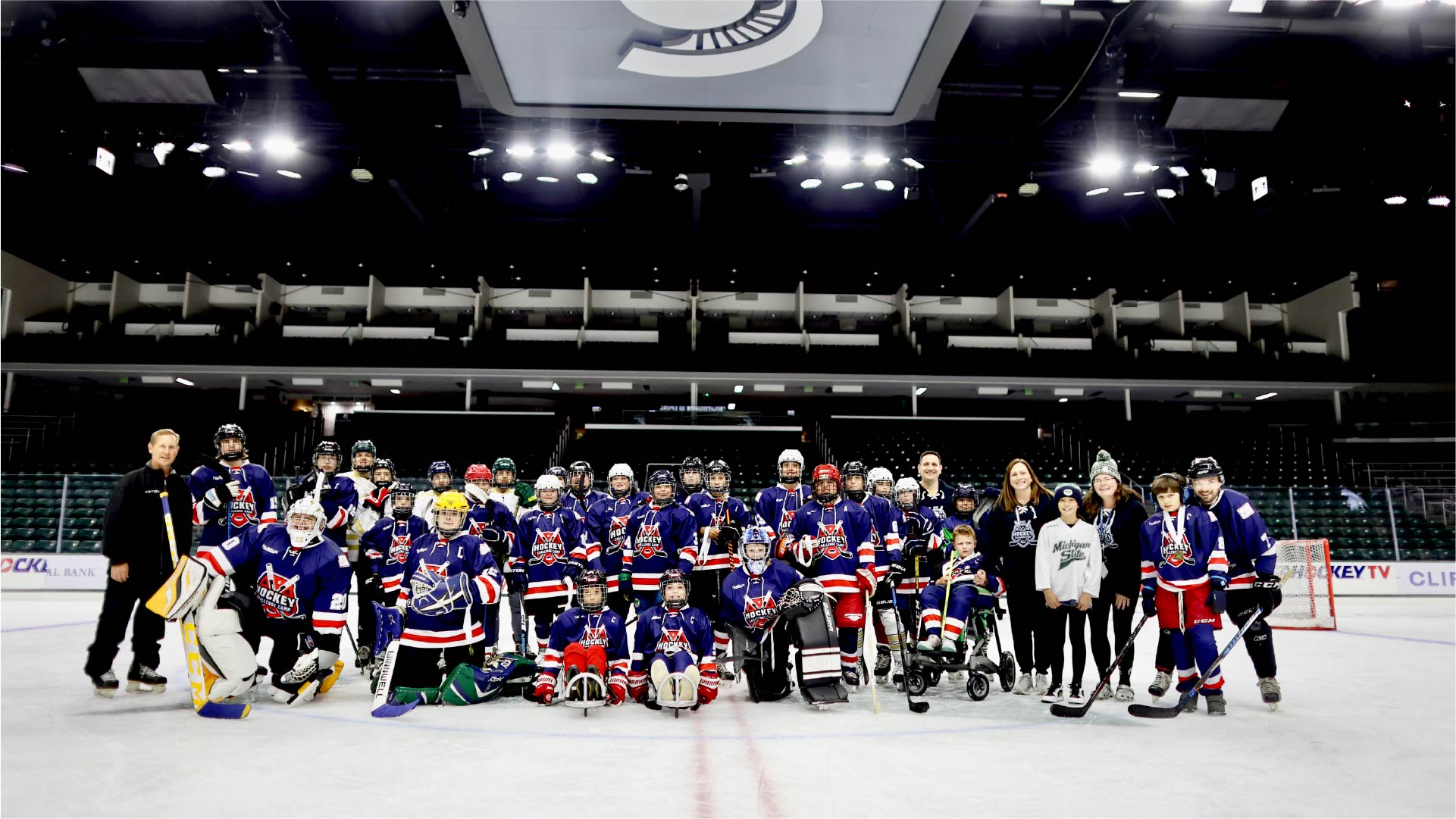
The Hockey Challenge Camp was honored by the National Hockey League in June 2025 with the Willie O’Ree Community Hero Award. With a $25,000 grand prize, this award will support the purchase of adaptive hockey equipment for players. Dunkel-Jackson credits the many layers of collaboration that brought the Hockey Challenge Camp and other SAFE Challenge programs to life for this win.
“I appreciate all of our coaches who do an amazing job at jumping in and being able to adapt different drills,” says Dunkel-Jackson. “I have so many coaches who have been there for 5 years, and we have players and buddies that have been there all 5 years, too. It is fun to see their progress!”
Along with providing equipment that players use for their sports, SAFE Challenge programs work to reduce inequality in access to sports programs by encouraging players to see themselves on the field and families to see themselves in the stands cheering for their kids. Prince Owusu, a doctoral student, coach with the Baseball Challenge League, and co-founder of the Center for Learning and Childhood Development (CLDC) in Ghana, shares that he has learned about the importance of reducing stigma around disabilities in sports through volunteering and research.
“It improves the morale of the children themselves, and it makes society see that children with disabilities can be involved in different activities as well,” says Owusu. The CLDC previously invited Dunkel-Jackson’s education abroad students learning about disabilities in an African context to host an event featuring a variety of adaptive sports. While the event was rained out, Dunkel-Jackson continued her consultation from afar and their partnership still yielded a SAFE Event a few months later including adaptive activities for the center and an engaged learning opportunity for the MSU students involved in the planning process.
“You become an advocate for people with disabilities and their families,” Dunkel-Jackson says of the opportunity for her students to volunteer with SAFE Challenge programs. “Anybody can be an advocate. We connect with a broad group of students, and I’m really excited that the people who maybe aren’t going to be in the helping professions as a career also get a chance to see that these kinds of programs are incredibly valuable.”