CCEL Visibility on the National Front
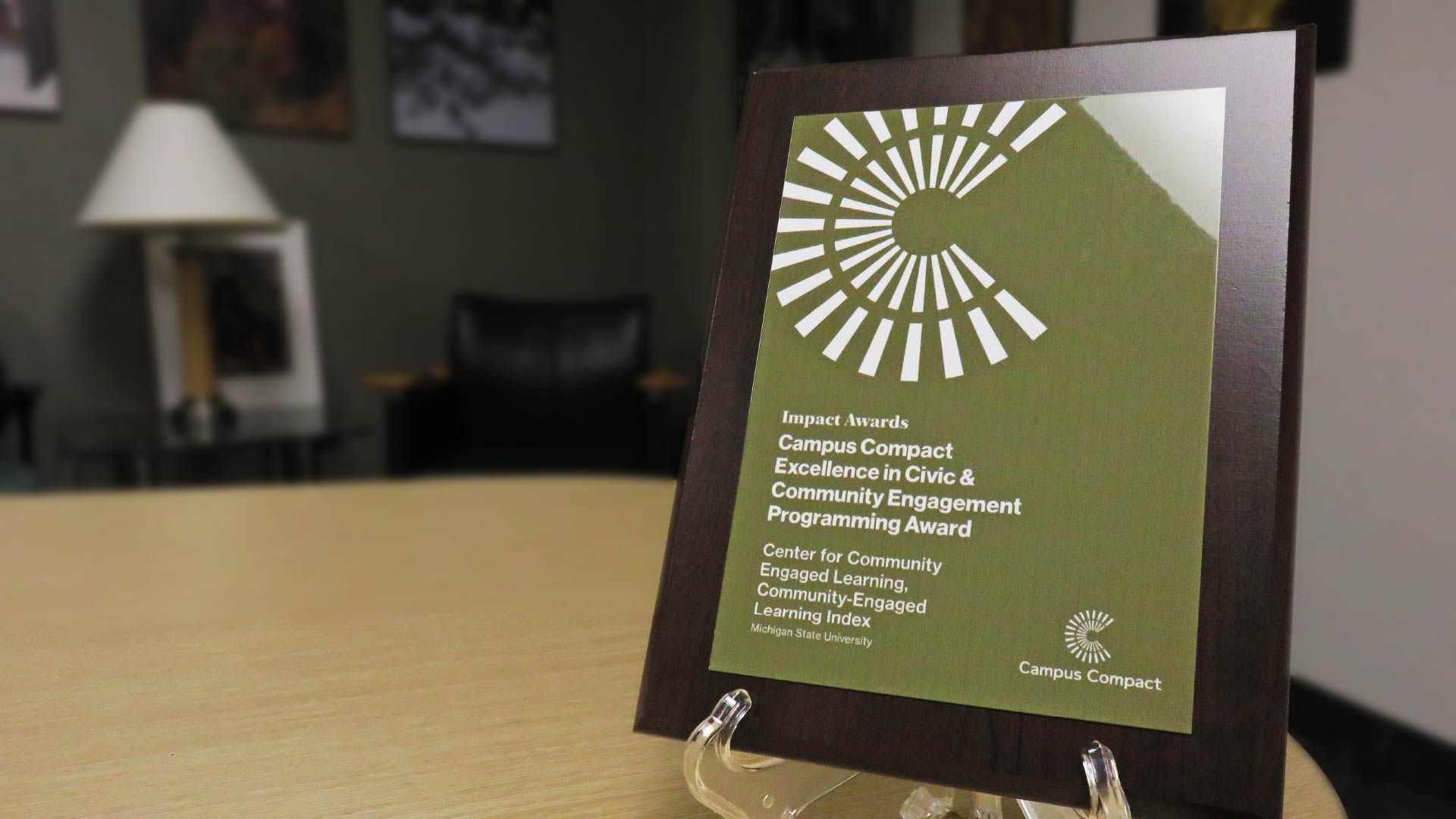
Recognition for CCEL Programs: #1 Service-Learning Ranking and Campus Compact Award
For the second straight year, in 2025 U.S. News & World Report ranked Michigan State University No. 1 in service-learning among public universities and No. 9 overall. This recognition for service-learning, known as community-engaged learning at MSU, shows the university’s commitment to integrating community partnerships with classroom instruction to enrich the student learning experience, teaching civic and social responsibility, and strengthening communities.
MSU's Center for Community Engaged Learning documents this work by surveying faculty, staff, and students for this Index. In March 2025, the Index received the 2025 Excellence in Civic & Community Engagement Programming Award from Campus Compact, a national organization that empowers universities and colleges to advance academic and civic missions through partnerships with communities. Campus Compact described the Index as “a powerful tool that not only tracks and evaluates CEL (community-engaged learning) activities across campus but also amplifies their positive impact.”
Kwesi Brookins, vice provost for University Outreach and Engagement, commended the center for maintaining MSU’s No. 1 ranking for service-learning and using the Index to showcase real-world impacts. “For more than a decade, the Index has been an essential resource for assessing and tracking community-engaged learning efforts at MSU, celebrating the contributions of the university’s students, faculty, and community partners in alignment with community engagement goals,” Brookins said.
The Campus Compact award and MSU’s No. 1 rank for service-learning are a testament to the MSU students who give hundreds of hours each year to community-engaged service, scholarship, and advocacy. “I am so proud of our Spartan community and partners,” said CCEL Executive Director Renee Miller Zientek. “The experiences shared by students and partners are what truly make a difference.”
2024-2025 Conference Presentations Overview
The Community-Engaged Learning Index and other CCEL initiatives were the subject of several national presentations in 2024-2025. The academic community-engaged learning team advanced community-engaged teaching and learning through a series of national and campus presentations on work grounded in the values of anti-racism, equity, and co-creation.
Stephanie Brewer, assistant director for community-engaged teaching and learning, and Michelle Snitgen, assistant director for faculty engagement and strategic initiatives, presented at three key conferences: the International Association for Research on Service Learning and Community Engagement (IARSLCE), Campus Compact 25, and MSU’s Spring TALKS.
At IARSLCE, Brewer and Snitgen presented on the development and growth of the CCEL Special Topics Series—a faculty development initiative designed to deepen practitioner knowledge, foster collaboration, and create a sustainable support network for community-engaged teaching and learning across MSU’s decentralized campus. Their session offered a model for workshop design grounded in theory-to-practice strategies, sharing tools, exemplars, and outcome data from the series, which has expanded to 10 core topic areas and engaged hundreds of participants nationwide.
At Campus Compact 25, Brewer and Snitgen facilitated two sessions. The first focused on their multiyear Community of Practice (COP) initiative, which outlined strategies for cultivating inclusive, critically informed learning communities dedicated to community-engaged teaching and learning. Themes have included critical and anti-racist teaching and learning, and outcomes have included publications, conference presentations, and deeper practitioner networks.
In a second session, Empowering Student Changemakers: The Social Innovation Speed Pitch Experience, Brewer and Snitgen showcased a workshop co-developed with the MSU Burgess Institute. This interactive session introduced students to social innovation through asset-based, community-centered design. Participants engaged in a Speed Pitch simulation and learned about the workshop’s expansion into a three-class series for first-generation student scholars.
The team also presented at the MSU Spring TALKS conference on a faculty learning community exploring Anti-Racist Community Engagement through a collaborative self-study. Additionally, they shared the development of the Social Innovation Speed Pitch workshop.
CCEL Executive Director Renee Miller Zientek actively contributed to the field of community-engaged learning through a series of national and campus-based presentations and facilitation efforts. At MSU’s Student Success Summit, she co-facilitated a roundtable titled Supporting Students’ Development of Purpose Through High Impact Practices, emphasizing the role of community-engaged learning in fostering student purpose and persistence. Nationally, she presented at the Campus Compact Conference, leading roundtable discussions on Partners for Democratic Engagement and Bridging Accountability and Community Engagement: Reimagining Institutional Practices for Equitable Partnerships, both of which explored strategies to align institutional engagement with democratic values and community priorities.
Zientek also co-facilitated a Sustained Dialogue Group (SDG) through the TRUCEN Network, focused on developing meaningful metrics of accountability for research universities engaged in civic work. She led a virtual lightning session highlighting diverse models of civic engagement minors, certificates, and distinction programs, showcasing national examples from Harvard College, the University of Delaware, and the University of California system. Additionally, she was invited to Columbia College to deliver a series of faculty development workshops covering core aspects of community-engaged learning, including course design, partnership building, and impact assessment. Through these efforts, Zientek strengthened institutional capacity, elevated national conversations, and advanced best practices in the field.
The newly piloted Spartan Volunteer Corps (SVC) was the subject of a roundtable discussion hosted by Assistant Director K.C. Keyton at Campus Compact 25. This discussion shared the model of the SVC as a student leadership program in community-engaged learning that inspired several revisions to the SVC structure planned for 2025-2026, including support for service-based registered student organizations and development of interest nights to explore community topics.
In collaboration with the Refugee Development Center, Assistant Director Tina Houghton spoke on a panel about Creating Opportunities through Service: How Engaged & Supported Volunteers Improve Adult Education, at the Michigan Adult, Community, and Alternative Education Association’s Virtual Spring Institute. This discussion delved into key topics such as volunteer recruitment, engagement strategies, fostering collaboration, building trust, and measuring impact with insights from volunteers and adult students.
As a follow-up to the Community-Engaged Learning Index’s recognition for Excellence in Civic & Community Engagement Programming, the Index team presented in a webinar hosted by Campus Compact. Miller Zientek, Brewer, Snitgen, CCEL Program Coordinator Sam Rothwell, and CCEL Program Assistant for Communications Catherine Anger, as well as UOE Communications and Information Technology (CIT) Associate Director Ghada Georgis and Graphic Artist Mike Davis discussed the process of creating the Index, highlighted community-engaged teaching and learning data, and future ideas for this publication. This webinar was the first of a series featuring Campus Compact’s 2025 Impact Award winners and concluded a year of visibility for CCEL programs.